
No products found
Types of Cartridge Filter Housings
Single Cartridge Filter Housings
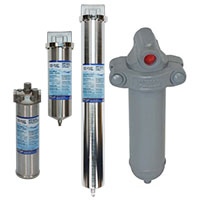
Single cartridge housings hold one filter cartridge and are designed for lower flow rate applications or point-of-use filtration. They are compact, economical, and easy to service. Common applications include equipment protection, sample points, small process lines, and laboratory or pilot-scale filtration. Single cartridge housings are available in stainless steel, including 304 and 316, carbon steel, and polypropylene.
Multi-Cartridge Filter Housings
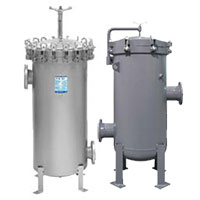
Multi-cartridge housings hold multiple cartridges and are designed for higher flow rates and larger-scale process filtration. Configurations range from a few cartridges up to 100+ elements depending on the model and manufacturer. Multi-cartridge housings distribute flow across all cartridges simultaneously, which reduces the pressure drop per element and extends cartridge life compared to running fewer cartridges at higher velocity. They are the standard choice for production-scale industrial, water treatment, food and beverage, and pharmaceutical applications.
How to Select the Right Cartridge Filter Housing
Flow rate is the primary sizing factor. Higher flow requirements need more cartridge positions or larger housing configurations. Your housing must handle the full volume of liquid moving through the system without exceeding the maximum recommended flow per cartridge.
Cartridge compatibility is critical. Cartridge housings are designed to accept specific cartridge sizes and end cap configurations. The key specifications to match are:
| Specification | Common Options |
|---|---|
| Cartridge length | 10 in., 20 in., 30 in., 40 in. |
| Cartridge diameter | Approximately 2.5 in. to 6 in. depending on style |
| End cap configuration | 222 flat, 222 fin, 226 flat, 226 fin, double open end, DOE |
| Seal type | Knife-edge seal, O-ring, flat gasket |
Make sure the housing you select is compatible with the cartridge type and end cap you intend to use. Some housings accept multiple configurations through interchangeable adapter plates.
Housing material must be compatible with your process liquid, temperature, and pressure. Options include:
- 316L stainless steel for corrosive liquids, food and beverage, pharmaceutical, and high-purity applications
- 304 stainless steel for general industrial use and water treatment
- Carbon steel for non-corrosive industrial applications at higher pressures
- Polypropylene for chemically aggressive liquids at lower pressures and temperatures, and for applications requiring zero metal contact
Maximum pressure and temperature ratings vary by model and material. Confirm that the housing rating meets or exceeds your operating conditions. Stainless steel housings typically handle higher pressures and temperatures than polypropylene.
Connection size and type must match your existing piping. Threaded NPT, flanged, and sanitary tri-clamp connections are available depending on the model and application.
Regulatory compliance may be required for certain industries. Stainless steel housings with sanitary finishes are available for FDA, USDA, and 3A dairy-compliant applications. ASME code stamps are available for housings that must meet pressure vessel certification requirements.
Cartridge Housing vs. Bag Filter Housing
Both cartridge and bag filter housings remove particles from liquids, but they serve different filtration needs.
| Factor | Cartridge Housing | Bag Filter Housing |
|---|---|---|
| Best for | Fine to sub-micron filtration, high purity | High flow, high dirt load, coarse to medium filtration |
| Typical micron range | Sub-micron to 100 micron | 1 to 800 micron |
| Filtration precision | Available in absolute-rated validated removal | Nominal rated |
| Cost per change | Higher, cartridges cost more than bags | Lower |
| Dirt-holding capacity | Lower per element | Higher per bag |
| Common pairing | Often used downstream of bag filtration as a polishing step | Often used upstream of cartridge filtration as a pre-filter |
Many systems use bag filtration as a pre-filter to remove bulk particulate matter, followed by cartridge filtration for final polishing. This combination extends cartridge life and reduces overall operating cost.
Performance and Maintenance
Cartridge filter housings require periodic cartridge replacement to maintain filtration performance. Monitor the differential pressure across the housing to determine when cartridges need to be changed. A recommended change-out threshold is approximately 30 PSI of differential pressure for cartridges, though the specific limit depends on your cartridge type and process requirements.
Cartridges should also be replaced if you observe reduced flow rate, a decline in product quality or clarity, or if the cartridge has reached the end of its recommended service interval.
For housings that need replacement parts such as O-rings, gaskets, or closure hardware, CFS stocks OEM components for all brands we carry.
Applications
Industrial cartridge filter housings from CFS are used across industries where high-purity filtration is required, including:
- Food and Beverage
- Chemical Processing
- Pharmaceutical and Biotechnology
- Water and Wastewater Treatment
- Reverse Osmosis Pre-Filtration
- Petroleum and Petrochemical
- Cosmetics and Personal Care
- Electronics and Semiconductor
- Paint, Coatings, and Inks
- Cooling Tower Filtration
All cartridge filter housings are genuine OEM products from authorized manufacturer partnerships.
Need help selecting the right cartridge filter housing? Call (855) 236-0467 or submit a quote request for sizing, pricing, and availability.